Bonamargy Friary
15th Century Friary and Stone Cross
The Third Order Franciscan Friary at Bun-na-Mairgie, modernised to Bonamargy, was founded by Rory MacQuillan in c.1500. It may have been built on an earlier foundation, possibly established by William de Burgo in the 13th century. MacQuillan was a descendant of the Anglo-Norman de Mandevilles. The dissolution of the monasteries in Ireland occured from 1536, but it appears the friars remained at Bonamargy until shortly after the friary was burned in 1584. The MacQuillans eventually lost control of the monastery to their fierce rivals the MacDonnells, Earls of Antrim, in 1588. The MacDonnells built a mortuary chapel onto the south-side of the church. There is a stone plaque on the outside of the chapel/vault dated 1621, see images below. A number of the Earls of Antrim were laid to rest at Bonamargy as well as Sorley Boy MacDonnell, see Kinbane Castle.

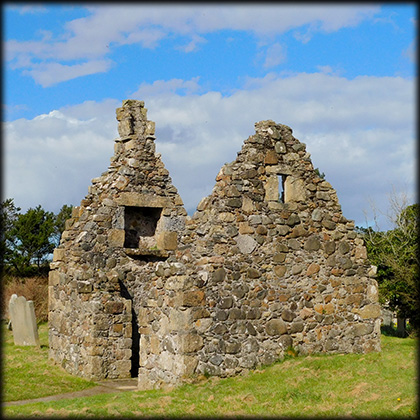
Access to the friary is through a delightful gatehouse, set in an earthen bank, see bottom image. The ruins consist of a long narrow church, with a sacristy and dormitory on the north-side of the east end and the MacDonnell chapel and vault are on the south-side. There were three windows and a door in the south wall. A beautiful tracery window was set into the east gable by Alice Macdonnell the first Countess of Antrim, probably at the time her husband built the family chapel. Most of the window tracery is now missing, but there are many fragments lying around the grounds of the friary.
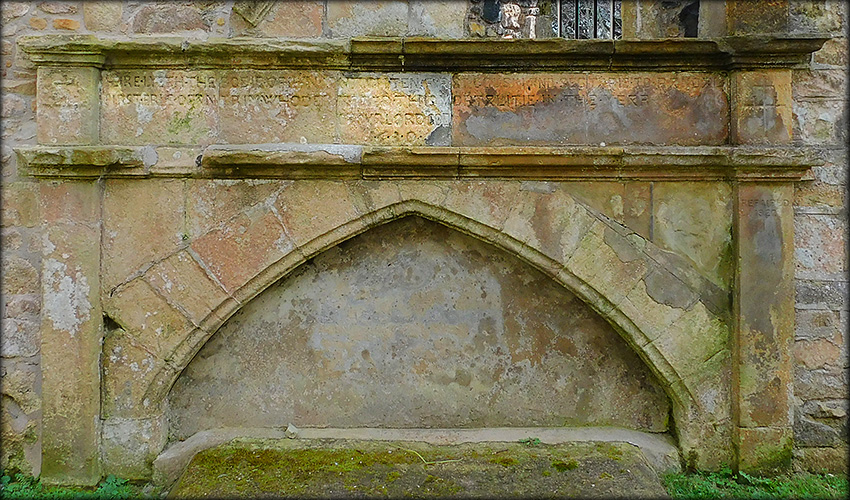
Against the interior of the south wall of the church is the Macnaghten tomb, erected in 1630. An inscription reads: HEIRE-LYETH-THE-BODIE-OF-IHN-MNAGHTEN-FIRST-SECRETAIRE-TO-THE-FIRST-ERLE-OF-ANTRIM-WH-ODEP-ARTED-THIS-MORTAL-LIFE-IN-THE-YEAR-OF-OVR-LORD-GOD-1-6-3-0. John Macnaghten was a nephew of Sorley Boy Macdonnell. In the graveyard are a number of mid-18th century gravestones bearing family crests.

A window in the south wall
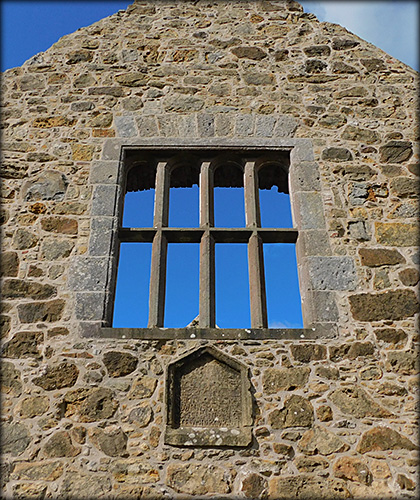
The south gable of the MacDonnell Chapel

A male head and square interlaced carving on the south side of the east window. There is a female head and more interlaced carving on the north side of the window. There are more carvings on stones just above each of these.
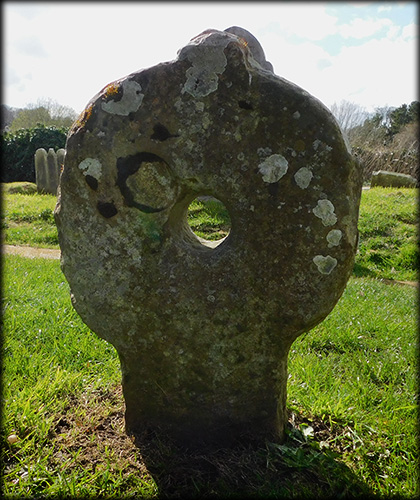
Perforated Stone Cross
The stone cross is traditionally believed to mark the grave of Julia MacQuillin, AKA "The Black Nun" In her latter years, the prophet and recluse, resided at the gatehouse of the friary around the middle of the 17th century. She requested to be buried at the doorway of the church, so all who entered would walk upon her grave. The ground level inside the church is now a metre higher than the original level and no remains of a burial were ever found near the cross. It may have been moved to Bonamargy from another church at a later date. A taller cross at Layd Old Church in Cushendall, also has a perforated head.

Situated: From Ballycastle head east on the A2 for about 0.5 Kilometres, Bonamargy Friary is on your right.
Discoverer Map 5: D 1267 4084. Last visit March 2023.
Longitude: 6° 13' 51.1 " W
Latitude: 55° 12' 07.5" N
Photos: José Gutiérrez.
Ref: Northern Ireland Sites and Monuments Record website.